Study For Buddies: TY Semester 5 theory
Showing posts with label TY Semester 5 theory. Show all posts

Thursday, September 30, 2021

Organizational Behaviour

September 30, 2021 0
Organizational Behaviour
T.Y B.COM
SEMESTER - 5

ORGANIZATIONAL BEHAVIORAL
(OB)
UNIT - 1 THEORY

CONTENTS TO BE COVERED:

• Meaning & definition of OB 
• Importance of OB 
• Nature of OB 
• Scope of OB 
• OB Framework 
• Contributing Disciplines to OB 
• SOBC model of OB

MEANING OF OB 

• Three features 
  1. Study of human behaviour 
  2. Behaviour in organizations 
  3. Useful in improving an organization’s effectiveness

DEFINITIONS 

• OB refers to the behaviour of individuals and groups within organizations and the interaction between organizational members and their external environment. 

• OB is a field of study that investigates the impact that individuals, groups and structure have on behaviour within organizations for the purpose of applying such knowledge towards improving an organization's effectiveness
 
• OB comprises individual behaviour, group behaviour and of the organization itself. 

• Influence of environment on the interface between individuals and organizations cannot be overlooked. 

• The field of OB is both exciting and complex 

• OB has emerged as distinct field of study.

IMPORTANCE OF OB 

1. OB provides a road map to our lives in organization. 

2. OB uses scientific research to helo us understand and predict organizational life. 

3. OB helps us influence organizational events. Though it is good to understand and predict organizational events, most of us want to influence the environment in which he or she lives. 

4. OB helps an individual understand himself/herself and others better.

5. Manager in a business establishment is concerned with getting things done through delegation. 

6. The field of OB is useful for maintaining cordial industrial relations. Human problems need to be tackled humanely. OB helps in understanding the cause of the problem, predict its course of action and control its consequences. It serves as the basis for HRM. 

7. OB is also useful in the field of marketing. Innovation and the diffusion of new products, creativity and the learning of responses are important social and individual phenomena.

8.The post popular reason for studying OB is that reader is interested in pursuing a_ career management and wants to learn how to predict behaviour and apply it in some meaningful way to make organizations more effective. 

9.Last couple of years, Our economy has been witnessing an upward trend. In order to sustain this trend, effective management of all sectors. Effective management does not mean competent utilization of resources. It means. efficient management of HR. This is where OB comes into picture.

NATURE OF OB 

• A field of study and not a discipline : discipline is an accepted science with theoretical foundation that serves as the basis for research and analysis. OB because of its broad base, recent emergence and interdisciplinary orientation is not accepted as science. Synthesise principles, concepts and processes in OB field of enquiry . 

• Interdisciplinary : integrates the relevant knowledge drawn from different disciplines for Specific purpose. OB integrates the relevant concepts from various disciplines to make them applicable for organizational analysis.

• An Applied Science : basic objective is to make application of various researches to. solve organizational problems, particularly related to human behaviour aspect. OB is both science as well as art. 

• Normative and Value centric : normative science prescribes how the various findings of the researches can be applied to get organizational results which are acceptable to the society. What is acceptable by the society or individuals engaged in organization is a matter of values of the society and people concerned
 
• Humanistic and Optimistic : OB focuses 
attention on people. It is based on the belief that needs and motivation of people are of high concern. Acceptance of value of the individual as a thinking, feeling organism. There is optimism abut the innate potential of man to be independent, creative, productive and capable of positively contributing to organizational objectives.

• Oriented towards organizational objectives : OB emphasising human aspect of the organization is oriented towards organizational objectives. Organization may have several objectives and sometimes conflicting with individual 
objectives. OB tries to integrate two types of objectives so that both are achieved 
simultaneously

• A total system approach : the living system of an organization is viewed as an enlargement of a man. System approach is an integrative approach which takes into account all the variables affecting organizational functioning. The System thinking in organizational analysis developed by behavioural scientist. It does not take human being in isolation but as the product of socio-psychological factors. Behaviour is analysed keeping in view psychological, interpersonal orientation, group influence and social & cultural factors.

SCOPE OF OB

OB encompasses the study of: 

• Intrapersonal behaviour : personality, attitude, perception, learning , opinion, motivation, job satisfaction and stress management 

• Interpersonal behaviour : group dynamics, team dynamics, intergroup conflict, leadership, communication, transaction analysis and the like 

• About Organizations : their formation, structures, effectiveness and formal and informal organizations.

• The three levels of analysis are not necessarily mutually exclusive. The field of OB embraces them as being complementary. 

• There is no “One Best way” 

• Specialist in the field of OB today agree that there is no one best approach when it comes to studying human behaviour in organizations.

CONTRIBUTING DISCIPLINES TO OB 

• PSYCHOLOGY : science that seeks to measure, explain and sometimes change the behaviour of humans and other animals. Psychologists are concerned with problems of fatigue, boredom and other relevant to working conditions that could impede efficient work performance. 

• Sociology : studies people in relation to their fellow human beings. Sociologists contribution to OB through their study of group behaviour in organizations, particularly formal and complex organizations.

• Social Psychology : blending concepts from both sociology and psychology and focuses on the influence of people on one another. Considerable investigation from social psychologists has been change - implement and reduce barriers. 

• Anthropology : study of societies to learn about human beings and their activities. Anthropologists work on cultures and environments, helps us understand differences in fundamental values, attitudes and behaviour among people in different countries and within different organization.

• Political Science : study of the behaviour of individuals and groups within political environment. It studies the behaviour of individuals and groups within a political environment.

SOBC MODEL OF OB 

• S-O-B-C model incorporates more complex mechanism of human behaviour which modifies and extends S-O-R model. 

• S-O-R model stands for Stimulus, Organism, Response. 

• S-O-B-C stands for Situation, Organism, Behaviour pattern and Consequence. 

• S- Situation - more comprehensive than stimuli and incorporates all aspects of the environment immediate stimuli, physical environment and socio-cultural environment

• O - Organism - does not only represent physiological being as in S-O-R model but also psychological being which is more complex. 

• B- Behaviour pattern both overt and covert 

• C- Contingent consequences 


• The interaction pattern among different elements of human behaviour model is not simple one but complex because of 2 reasons: 

(A) different variables with each elements which interact among themselves.
(B) Organisms is not physiological being 

• Only O interacts with the situation and base on his own nature he may perceive the situation ina particular way and behave accordingly. 

• Though SOBC model tries to explain the process of human behaviour, it presents only a bare bone sketch of the behaviour.

For More Detail Contact Us And Follow On Study For Buddies

Thank You

Tuesday, July 13, 2021

Advanced Accounting - Accounting for Amalgamations

July 13, 2021 0
Advanced Accounting - Accounting for Amalgamations
T.Y B.COM
SEMESTER - 5

ADVANCED ACCOUNTING
UNIT - 1
CHAPTER - 1

ACCOUNTING FOR AMALGAMATIONS

Amalgamation:

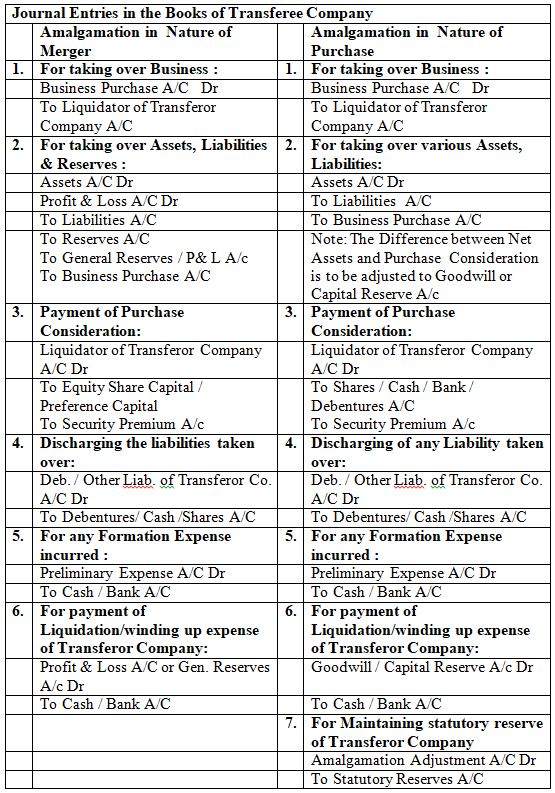
The term amalgamation is used when two or more existing companies go in to liquidation and a new company is formed to take over their business. The term absorption is used when one or more existing companies go into liquidation & one existing company takes over or purchases their businesses. However this difference between amalgamation & absorption has been dispensed with the Accounting Standard (AS-14) ‘Accounting for Amalgamations’ issued by ICAI. Thus amalgamation means merging of one company with another company or merging of two or more companies to form a new company or one company is taken over by the other. Hence amalgamation includes absorption. In amalgamation the assets & liabilities of transferor company(ies) are amalgamated with the transferee company. 
AS-14 specifies the procedure of accounting for amalgamations and the treatment of any resultant goodwill or reserves. The following terms are used in this standard with reference to amalgamation of companies.

a) Amalgamation : means an amalgamation pursuant to the provisions of Companies Act, 1956 or any other statute, which may be applicable to companies.
b) Transferor : Company means the company which is amalgamated in to another co.
c) Transferee : Company means the company into which Transferor Company is amalgamated.
d) Reserve : Means the portion of earnings, receipts or other surplus of an enterprise (Whether (C) Capital or (R) Revenue) appropriated by the management for a general or a specific purpose other than a provision for depreciation or diminution in value of assets or for known liability.

Types of Amalgamation:

Amalgamation for accounting purpose can be classified into two categories.

1. Amalgamation in the nature of merger
2. Amalgamation in the nature of purchase.

Amalgamation in the nature of Merger:

This is a type of amalgamation which satisfies all the following conditions.

1. All the liabilities and assets of the transferor company become after amalgamation, The liabilities and assets of the transferee Company.
2. Shareholders holding not less than 90% of the face value of the equity shares of the transferor company become equity shareholders of transferee company by virtue of the amalgamation.
3. The consideration for the amalgamation receivable by those equity shareholders of transferor company who agree to become equity shareholders of the transferee company is discharged by the transferee company wholly by issue of equity shares in transferee company except that cash may be paid for in respect of any fractional shares.
4. The business of the transferor company is intended to be carried on by the transferee Company
5. No adjustment is intended to be made to the book value of the assets and liabilities of Transferor Company when they are incorporated in the accounts of Transferee Company, except to ensure that the accounting policies are uniform.

Amalgamation in the nature of Purchase: 

Amalgamation may be considered in the nature of purchase when any one or more of the five conditions specified for amalgamation in the nature of merger is not satisfied. These amalgamations which are in effect a mode by which one company acquires another company & hence the equity shareholders of the combining entities do not continue to have a proportionate share in the equity of the combined entity or the business of the acquired company is not intended to be continued after amalgamation.

Purchase Consideration:

According to AS-14, purchase consideration for the amalgamations means the aggregate of the shares & securities issued and the payment made in the form of cash or other assets by the transferee company to the shareholders of the transferor company. Purchase consideration does not include the amount of liabilities taken over by the transferee company or the amount paid directly to the creditors of the transferee company.

There are differented methods in which consideration may be calculated :

1. Lump Sum method :

This is the simplest method. The amount to be paid by Transferee Company as purchase consideration may be stated in the problem as lump sum. In such case no calculation is required. For example it may be stated that A Ltd. takes over the business of B Ltd. for Rs. 25,00,000. Hence the sum of Rs. 25,00,000 is purchase consideration.

2. Net Payment Method :

Under this method, the purchase consideration is ascertained adding up the total payments made by transferee in whatever form either in shares, debentures or in cash to the liquidator of the transferor company for payment to equity shareholders and preference shareholders of the transferor company. While ascertaining the purchase consideration, care should be taken of the following:

a) The value of assets and liabilities taken over by the transferee company are not to be considered.
b) The payments made by the transferee company for shareholders whether in cash or in shares or in debentures must be taken into account.
c) Where the liabilities are taken over by the transferee company & subsequently discharged such amount should not be added to purchase consideration.
d) When liabilities are taken over by transferee company they are neither deducted nor added to the amount arrived at as purchase consideration.
e) Any payments made by transferee company to some other party on behalf of the transferor company are to be ignored.
f) If the liquidation expenses of the transferor company are paid by the transferee company the same 
should not be taken as a part of the purchase consideration.
g) If any liability is not taken over by the transferee the same should be excluded.
h) The term business will always mean both the Assets and Liabilities of the company.

3. Net Assets Method :

Normally the net payment method is used to compute the purchase consideration. However, it cannot be used if details of all payments are not available e.g. in case where the purchasing company agrees to pay, say by way of 1,000 shares and the balance in cash, the purchase consideration is determined by adding up the ‘agreed values of all assets taken over’ and deducting the ‘agreed value of all liabilities taken over’. While determining the amount of purchase consideration under this method, care should be taken of the following:

a) The term ‘Assets’ will always include cash in hand and cash at bank, unless otherwise stated but shall not include any fictitious assets like preliminary expenses, underwriting commission, discount on issue of shares or debentures, profit and loss account (debit balance), etc. 
b) Asset not taken over by Transferee company should be excluded.
c) If there is goodwill or prepaid expenses, the same should be included in the assets taken over unless otherwise stated.
d) The term ‘liabilities’ will mean all liabilities to third parties.
e) The term ‘trade liabilities’ will mean trade creditors and bills payable. 
f) The term ‘liabilities’ shall not include any past accumulated profits and reserves such as general reserve, reserve fund, sinking fund, dividend equalization fund, capital reserve, share premium account, capital redemption reserve account, profit and loss account etc. These are payable to the shareholders and notto the third parties. 
g) If any fund or portion of any fund denotes liability to third parties the same must be included in Liabilities such as staff provident fund, workmen’s savings bank account, workmen’s profit sharing fund, workmen’s compensation fund (up to the amount of claim if any), etc.
h) If any liability is not taken over by the transferee the same should be excluded.
i) The term businesses will always means both the Assets and Liabilities of the Company.

4. Intrinsic worth/ Share Exchange Method :

In this method, purchase consideration is ascertained on the basis of the ratio in which the shares of the transferee company are to be exchanged for the shares of the transferor company. The exchange ratio is generally determined on the basis of the intrinsic value of each company shares.

Methods of Accounting for Amalgamations :

According to AS 14 there are two methods of accounting for amalgamations : 

1. Pooling of Interests Method : 

This method issued in case of amalgamation in nature of merger. The accounting is done in the following manner.
a. The assets, liabilities, profit & loss account and reserves (whether capital, revenue or revaluation reserves) of the transferor company are recorded in the books of the transferee company at the same values and in the same form as at the date of amalgamation. This reflects the fact that the entries are simply merged together. No goodwill account should be accounted for.
b. If at the time of amalgamation, the transferor and transferee companies have conflicting accounting policies, a uniform set of accounting policies should be adopted following amalgamation.
c. The difference between the amounts recorded as share capital issued (plus any additional consideration in the form of cash or other assets) and the amount of share capital of Transferor Company should be adjusted against reserves of Transferee Company.

2. Purchase Method :

This method is used for amalgamation in nature of purchase. The application of method involves the following:
a) The assets and liabilities of the transferor company should be incorporated in the books of transferee company on the basis of their agreed values (i.e. either book values or the fair values).
b) The reserves (whether capital, revenue or revaluation reserves) of the transferor company other than the statutory reserves should not be included in the financial statements of the transferee company. 
c) Any excess of the purchase consideration over the value of net assets of the transferor company should be treated as goodwill and debited to goodwill account. On the other hand if purchase consideration is lower than the value of net assets acquired, the difference should be credited to capital reserve. AS-14 recommends that goodwill arising on amalgamation should be amortized over a period of five years unless a somewhat longer period can be justified. 
d) No reserves, other than statutory reserves, of the transferor company should be incorporated in the financial statements of the Transferee Company. Statutory reserves of the transferor company should be incorporated in the balance sheet of the transferee company by way of the following journal entry.

Amalgamation Adjustment A/c             Dr.
               To Statutory Reserves A/c 

When the above statutory reserves will no longer be required to be maintained by transferee company, such reserves will be eliminated by reversing the above entry.

Journal Entries in the Books of Transferor Company:

1 Assets Transfer :

Realisation A/C                     Dr
                To Assets A/C

2. Transfer of Liabilities taken over by transferee company :

Liabilities A/C                       Dr
          To Realisation A/c

3. Transfer preference share capital to preference share holder :

Preference share capital A/C Dr
                 To preference share holder A/C

4. Transfer of Equity Capital & Reserves :

Equity Share Capital A/C Dr
Reserves & Surplus A/C Dr
               To Equity Share holder A/C

5. Transfer of Accumulated Losses or Fictitious Assets :

Equity Shareholders A/C Dr
                To Accumulated Loss/Ficti. Assets A/C

6. For Purchase Consideration Due :

Transferee Company A/c       Dr
           To Realisation A/C

7. For Purchase Consideration received :

Cash / Bank A/C                Dr
Equity Shares / Preference Shares / Deb.  In Transferee Co A/C         Dr
                To Transferee Co A/C

8. For Disposing assets not taken over by Transferee Co :

Cash / Bank A/C                   Dr
               To Realisation A/C

9. For payment of liabilities not taken over by Transferee company :

Liabilities A/c               Dr
                  To Cash / Bank A/C

10. For liquidation expenses : 

a. Paid by Transferor Company

Realisation A/C Dr
           To Cash / Bank A/C

b. Paid by Transferee Company

 No Entry

c. Paid first by Transferor and later recovered

 Transferee Co A/C                Dr.
                       To Cash A/C
 Cash A/C                              Dr.
                       To Transferee Co A/C

11. Payment of Preference shareholders :

Preference share holder A/C      Dr 
               To Equity/Pref Sh. in Transferee Co/ Cash /Bank A/C

12. To close Realisation Accounts :

a. In Case of Profit : 

Realisation A/C               Dr
             To Equity share holder A/C

b. In Case of Loss : 

Equity share holder A/C Dr
               To Realisation A/C 

13. Close Equity Share Holder Accounts :

Equity shareholders A/C Dr
              To Equity share / Preference Share / Cash / Bank A/C

Advanced Accounting


For More Detail Contact Us And Follow On Study For Buddies

Thank You

Thursday, July 8, 2021

Financial Management - Financial Statement Analysis

July 08, 2021 0
Financial Management - Financial Statement Analysis
T.Y B.COM
SEMESTER - 5

FINANCIAL MANAGEMENT
(FM)
THEORY

UNIT 1
CHAPTER - 2

FINANCIAL STATEMENT ANALYSIS

LIQUIDITY RATIOS :
 
• "Liquidity" refers to the ability of the firm to meet its current liabilities. 
• The liquidity ratios, therefore, are also called 'Short-term Solvency Ratios.' 
• These ratios are used to assess the short-term financial position of the concern.
• They indicate the firm's ability to meet its current obligations out of current resources. 
• In the words of Salomon J. Flink, "Liquidity is the ability of the firm to meet its current obligations as they fall due. 
• In the words of Herbert B. Mayo, "Liquidity is the ease with which assets may be converted into cash without loss." 

Short-term creditors of the firm are primarily interested in the liquidity ratios of the firm as they want to know how promptly or readily the term can meet its current liabilities. If the firm wants to take a short-term loan from the bank, the bankers also study the liquidity ratios of the firm in order to assess the margin between current assets and current liabilities.

Liquidity ratios include two ratios: 

1. Current Ratio
2. Quick Ratio

1. Current Ratio :

The ratio is used to assess the firm's ability to meet its short-term liabilities on time. It is generally believed that 2:1 ratio shows a comfortable working capital position. However, this rule should not be taken as a hard and fast rule, because ratio that is satisfactory for one company may not be satisfactory for other. It means that current assets of a business should, at least be twice of its current liabilities. The reason of assuming 2: 1 as the ideal ratio is that the current assets include such assets as stock, Cash, debtors etc, from which full amount cannot be realized in case of need. Hence, even if half the amount is realized from the current assets on time, the firm can still meet its current liabilities in full. 

Current Assets = Cash & Bank Balance + Stock + Debtors + Bills Receivable + Prepaid Expenses + Investments readily convertible into cash (marketable securities) 

Current Liabilities = Creditors + Bills Payable + Bank Overdraft + outstanding exp + Provision for Taxation + Proposed Dividend. 

Formula:

Current ratio = Current Assets / Current Liabilities 

Significance: 

It provides a measure of degree to which current assets cover current liabilities. The excess of current assets over current liabilities provides a measure of safety margin available against uncertainty in realization of current assets and flow of funds. The ratio should be reasonable. It should neither be very high or very low. Both the situations have their inherent disadvantages. A very high current ratio implies heavy investment in current assets which is not a good sign as it reflects underutilization or improper utilization of resources. A low ratio endangers the business and puts it at risk of facing a situation where it will not be able to pay its short-term debt on time. If this problem persists, it may affect firms credit worthiness adversely. Normally, it is safe to have this ratio within the range of 2:1.

2. Quick Ratio:

Quick or Acid Test indicates whether the firm is in a position to pay its current liabilities immediately. 

An ideal acid test ratio is said to be 1:1. The idea is that for every rupee of current liabilities, there should at least be one rupee of liquid assets. This ratio is better test for short-term financial position of the company than the current ratio. Liquid assets are obtained by deducting stock-in-trade from current assets. 

Stock is not treated as a liquid asset because it cannot be readily converted into cash.

Formula : 

Liquid ratio = Current Assets - Stock In Trade / Current Liabilities

Significance: The ratio provides a measure of the capacity of the business to meet its short-term obligations without any flaw. Normally, it is advocated to be safe to have a ratio of 1:1 as unnecessarily low ratio will be very risky and a high ratio suggests unnecessarily deployment of resources in otherwise less profitable short-term investments.

EXAMPLES

Ex.1 Calculate Current Ratio and Liquid Ratio from the following information: 

Inventories 50,000 
Trade receivables 50,000
Advance tax 4,000 
Cash and cash equivalents 30,000 
Trade payables 1,00,000 
Short-term borrowings (bank overdraft) 4,000

Solution:

Current Ratio = Current Assets / Current Liabilities 

Current Assets = Inventories + Trade receivables + Advance tax + Cash and cash equivalents
                           = Rs. 50,000 + Rs. 50,000 + Rs. 4,000 + Rs. 30,000 = Rs. 1,34,000

Current Liabilities = Trade payables + Short-term borrowings 
                               = Rs. 1,00,000 + Rs. 4,000 = Rs. 1,04,000

Current Ratio = Rs.1,34,000 / 1,04,000
                        = 1.29 : 1 

Liquid Ratio = Current Assets – Stock / Current Liabilities
                    = 1,34,000 – 50,000 / 1,04,000                      = 0.81 : 1

2. If current ratio is 3:1, working capital is Rs.15,00,000. Calculate the current assets.

3. P Ltd. has current liabilities Rs. 30,000. Current ratio 3:1 and quick ratio 1:1. How much is stock-in-trade?

4. Balance sheet of KABEL Ltd. Indicates that its current ratio is Rs.2.5:1 and its net working capital is Rs.30,00,000. Find out the amount of current assets. (50,00,000)

5. Following trend ratios have been extracted from the audited records at a large sized industrial company:

Particulars

Current ratio

Acid test ratio

2010

1.80 : 1.00

1.70 : 1.00

2011

1.90 : 1.00

1.20 : 1.00

2012

2.10 : 1.00

0.90 : 1.00

2013

2.20 : 1.00

0.70 : 1.00

2014

2.90 : 1.00

0.60 : 1.00


Interpret the trend of these interrelated ratios for judging the short-term liquidity and solvency of the company.

Answer : 

From the data available it is observed that the current ratio has increased from 1.80 :1.00 to 2.90 : 1.00 in a span of 5 years. The ideal ratio is 2.00:1.00. This improvement in current ratio must reflect in the improvement of short-term solvency. But when we analyze the acid test ratio, it is fallen down from 1.70 : 1.00 in 2010 to 0.60 : 1.00 in 2014. This means that most of the current assets are blocked up in stocks over a period of time. The ideal standard acid test ratio is 1.00 : 1.00. It means that the company is not in a position to meet its immediate current liabilities; it may lead to technical insolvency. Hence steps should be taken to reduce the investment in inventory and see that the acid test ratio is above the level 1.00 : 1.00.

For More Detail Contact Us And Follow On Study For Buddies

Thank You
Wednesday, June 30, 2021

FINANCIAL MANAGEMENT - THEORY

June 30, 2021 13
FINANCIAL MANAGEMENT - THEORY
T.Y B.COM
SEMESTER - 5

FINANCIAL MANAGEMENT
(FM) - THEORY
UNIT - 1
CHAPTER - 1

 • IMPORTANCE OF FINANCE
 • SCOPE OF FINANCIAL MANAGEMENT
 • THE CORE CONCEPTS OF FINANCIAL MANAGEMENT
 • OBJECTIVES
 • FINANCE FUNCTION
 • ORGANISATION OF FINANCE FUNCTION

IMPORTANCE OF FINANCE:

Finance is considered to be the life blood of the business. A business need funds at every stage viz., at the inception, for inventories, fixed assets, working capital and later on for repayment of liabilities, expansion, development and modernization activities etc. it is hardly possible to think of any business activity without finance. Finance constitute the very base upon which the super structure of a modern corporate enterprise is erected. The corporate enterprises use different sources of funds for their growth. A corporate enterprise could grow and build a sound financial base only if it gets adequate finance and that too at reasonable cost. 

A major function of finance manager is to get funds at the lowest possible cost for the firm. However, the process does not end with the acquisition of the funds but perhaps starts with the intent of making the most judicious use of funds that have been acquired. The management should have clear idea of using the money profitably. The success or failure of any organization depends largely on how efficiently the funds are managed i.e. raised and invested in the business. Inefficient management of funds can lead not only to a loss of profit but also to an ultimate downfall of the concern. Without adequate finance no business can survive and without sound financial management no business can prosperous and grow. An efficient management of funds is therefore necessary for a sound base of financial position of a concern. 

The sound financial position is a prerequisite for survival, growth and for earning maximum return on investment in assets in any company. The importance of financial management is reflected in following areas of finance:

1. Financial Planning

Financial management helps to determine the financial requirement of the business concern and leads to take financial planning of the concern. Financial planning is an important part of the business concern, which helps to promotion of an enterprise.

2. Acquisition of Funds

Financial management involves the acquisition of required finance to the business concern. Acquiring needed funds play a major part of the financial management, which involve possible source of finance at minimum cost.

3. Proper Use of Funds

Proper use and allocation of funds leads to improve the operational efficiency of the business concern. When the finance manager uses the funds properly, they can reduce the cost of capital and increase the value of the firm.

4. Financial Decision

Financial management helps to take sound financial decision in the business concern. Financial decision will affect the entire business operation of the concern. Because there is a direct relationship with various department functions such as marketing, production personnel, etc.

5. Improve Profitability

Profitability of the concern purely depends on the effectiveness and proper utilization of funds by the business concern. Financial management helps to improve the profitability position of the concern with the help of strong financial control devices such as budgetary control, ratio analysis and cost volume profit analysis.

6. Increase the Value of the Firm

Financial management is very important in the field of increasing the wealth of the investors and the business concern. Ultimate aim of any business concern will achieve the maximum profit and higher profitability leads to maximize the wealth of the investors as well as the nation.

7. Promoting Savings

Savings are possible only when the business concern earns higher profitability and maximizing wealth. Effective financial management helps to promoting and mobilizing individual and corporate savings. Nowadays financial management is also popularly known as business finance or corporate finances. The business concern or corporate sectors cannot function without the importance of the financial management.

SCOPE OF FINANCIAL MANAGEMENT : 

Financial management and other areas of management: 

Financial management is one of the important part of overall management, which is directly related with various functional departments like personnel, marketing and production. Financial management covers wide area with multidimensional approaches. The relationship between financial management and other functional areas of management is as follows:

1. Financial Management and Production Department

Profit of the concern depends upon the production performance. Production performance needs finance, because production department requires raw material, machinery, wages, operating expenses etc. These expenditures are decided and estimated by the financial department and the finance manager allocates the appropriate finance to production department. The financial manager must be aware of the operational process and finance required for each process of production activities. The production department may be required to take various decisions like increase in capacity utilization, replacing machinery, improvisations of production facilities etc. All these decisions have financial implications and therefore, should be evaluated in the light of the objective of the maximization of shareholders wealth. So, the financial management has a role to play.

2. Financial Management and Personnel Department

Financial management is also related with Personnel Department, which provides manpower to all the functional areas of the management. The Personnel Department has to work with the finance manager while evaluating different schemes of training programmes, employee’s welfare, incentive schemes, revision of pay scales etc. Financial manager should carefully evaluate the requirement of manpower to each department and allocate the finance to the Personnel Department keeping in view both the employee’s welfare and the interest of the firm. Hence, financial management is directly related with Personnel Department.

3. Financial Management and Marketing

The marketing department is concerned with the ultimate activity of the firm i.e , the selling of goods and services to customers. Produced goods are sold in the market with innovative and modern approaches. For this, the marketing department needs finance to meet their requirements. The financial manager or finance department is responsible to allocate the adequate finance to the marketing department. Hence, marketing and financial management are interrelated and depends on each other.

4. Financial Management and Research and Development

The management requires finance to carry out various activities aimed at developing new products or improving existing product. The organization needs to maintain a separate reserve to finance its research and development activities on regular basis.

THE CORE CONCEPTS OF FINANCIAL MANAGEMENT 

Financial Management is primarily a decision making activity involving investment and financing decisions, which are guided by a set of core concepts and the goal of shareholder’s wealth maximization(Jim McMenamin).

The theory of financial management is based upon following axioms/core concepts:

1) CASH FLOW

This axiom refers to the difference between the accounting profit which is based upon the accounting concepts and conventions, and the cash flows which are based on the movement of cash. In Financial Management, the cash flow is the basic measurement tool. There are two dimensions of cash flows: cash inflows and cash outflows, and cash flow management involves the effective management of both. An organization’s cash flows will arise as a result of:

1) Operative activities; 
2) Investing activities; and 
3) Financing activities. 

Accounting Perspective
                                Rs.
Sales ……...…..   5,00,000
Costs …...…….   4,50,000
                        ------------------
Profit …….......     50,000
 

Financial Management Perspective
                                        Rs.
Cash inflows …….....  4,20,000
Cash outflow .......... 4,50,000
                                 -------------------
Net cash flow ……...   (30,000)

The financial management perspective reveals more clearly the financial condition of the business. It would be the key part of the financial manager’s role, in any organization, to monitor cash flows closely and take appropriate steps to minimize the risk of customer non -payment and insolvency. 

 Cash Inflow = Net Profit + Depreciation +/- other Non-Cash items
 Free Cash Flow = cash flow – (Investment Expenditures + Dividends)

However it is measured or defined, Cash flow generation is the true test of a firm’s performance and is vital for its long-term survival and growth. 

2) RISK AND RETURN

This axiom refers to that no investor will take additional risk unless he expects to be compensated with additional return. The motivation for undertaking an investment decision is the expectation of gaining a satisfactory return – a return which rewards effort and justifies the risk. But the return from an investment, particularly a business investment is not guaranteed. 

The actual return may prove to be more than, less than, or equal to, the return expected before the investment was undertaken. Investment decisions are typically made with imperfect knowledge of the future, and necessarily involve risk; how much risk depends on the nature of investment. 

In the context of financial management, by risk we mean the chance that the actual returns may differ from the expected returns, and in finance a risky investment is one whose potential returns are expected to have a high degree of variation or volatility. Remember that in financial management, returns are measured in terms of expected future cash flows – not profit , and the risk is the degree of volatility surrounding expected future cash flow return. A finance manager cannot avoid the risk altogether nor he can make a decision by considering the return aspect only. Usually, as the return from an investment increases, its risk also increases. In an attempt to increase the return, the finance manager will have to undertake greater degree of risk also. Therefore, a finance manager is often required to tradeoff between the risk and return. A particular combination of risk and return where both are optimized may be known as Risk-Return tradeoff. Every financial decision involves such tradeoff between risk and return. At this level of risk-return, the market price of the share will be maximized. Investment decision will be influenced by the investor’s propensity for risk taking, or the investor’s attitude to risk.

3) THE TIME VALUE OF MONEY 

Not only is the concept of measuring return in terms of cash flows important in financial management, but it is also the timing of cash flow returns which is vitally important. It is the timing of cash flows, as well as their size, which determines their value. You may have heard the expression; ‘A rupee today is worth more than a rupee tomorrow’. Cash flows which are to be received at some time in the future, say, one or two years from now, have less value than the equivalent cash flows to be received today. Cash received today can be reinvested in other investments to generate more cash flows. They could at least be placed in a deposit account to earn interest, thereby increasing their future value. This raises the notion that there is an opportunity cost (see next concept) associated with investment cash flows, because alternative investment opportunities always exist. 

4) OPPORTUNITY COST

To attract finance for its investments plans, a firm must offer potential investor an attractive rate of return, a rate of return which is competitive with the rate an investor could obtain elsewhere on an alternative investment of equal risk. From an investor’s perspective the opportunity cost of investing in a company, say ‘A’, would be the return given up by not investing in another comparable investment for one with a lower expected return. 

The firm’s opportunity cost of capital is the rate of return the firm must pay to investor to induce them to part with their money. Thus, the cost of capital to the firm is the opportunity cost of the next best investment alternative of equal risk available to the investor. This opportunity cost of capital is the rate of return which should be used to test the firm’s investment decisions. In simple terms, potential investments which are expected to earn less than this rate of return should be rejected. Those which are expected to earn an equal or higher rate of return should be accepted. 

5) VALUE 

The process of value creation is the driving force behind financial management and creating wealth for shareholders by increasing the value of their investment in the business is the central goal of financial management. This goal is the focus of all the financial decision. 

When making investment and financial decision, the finance manager clearly cannot assess their impact on shareholders’ value without first analyzing their effect on the firm’s cash flow, their timing and on its risk. 

If value-enhancing investment and financial decisions are made, this will be reflected in an increase in the firm’s value. In the case of a public company, shareholder can expect to see their wealth increase through an increase in the market value of the company’s shares. 

For a public company maximizing shareholder value in essence means maximizing the market value of the firmas reflected in its long-run share price and a shareholder’s wealth at any point in time is measured by the market value of the share hold. The market value of the firm can be defined as;

Total MV of firm = MV of its debt + MV of its equity.

In summary, the concepts of cash flow, the time value of money, risk-return and the 
opportunity cost affect the firms’s value in following ways:

1. Cash Flows : the greater the volume of positive cash flows the firm is expected to generate , the greater will be its value assuming all other factors remain constant.

2. Time value of money : The sooner cash flows are expected to be received; the greater will be their value, all other factors remaining constant.

3. Risk : The more risky or variable cash flows are expected to be, the lower will be the value of the investment again assuming all other factors remain constant.

4. Opportunity cost : The lower the return an investment offers compared to similar investments of equal risk, the lower its value, all other factors remaining unchanged.

OBJECTIVES :

Financial management is concerned with raising of funds and use (investment) of funds. The funds raised by the firm should be used in such a way that the earnings are maximized. This is the main aim of financial management. The another aim of financial management is to maximize the wealth of the shareholders. The wealth of the shareholders can be maximized by increasing the market price of the shares. If the benefit from the investment of the funds in assets is more than the cost, there shall be surplus and this will increase the market price of shares. This rise in market price of shares will maximize the wealth of the shareholders. Higher the market price of shares, the greater will be the wealth of the shareholders. So there are two main objectives of financial management:

1. Profit Maximization and
2. Wealth Maximization

A. Profit Maximization :

Profit earning is the main aim of the business. A business must earn profit to cover its cost. No business can survive without profit. Profit also serves as a protection against risks or adverse conditions. Thus, accumulated profits (or reserves or retained earnings) are very much useful to face the adverse conditions of the business like rise in material prices, increase in wage rates, reduction in selling price due to severe competition with other firms, adverse govt. policies etc. Thus, profit maximization is a main goal of the business. 

The following arguments are in favour of profit maximization: 

1. No business can survive without profit. So, profit is essential for survival of any business.

2. Profitability is a barometer for measuring efficiency of the management and economic prosperity of the business. So, it is justified on the grounds of rationality.

3. The business has to face some adverse conditions like recession, depression, severe competition etc. A business will survive under adverse condition, only if it has some past accumulated profits or reserves or retained earnings. Therefore all firms will try to earn more and retain more when the business is favourable for their future use.

4. Profit is the main source of finance for the expansion, growth and development of the business. So, every business will try to earn more and retain it for its future expansion, growth and development.

5. Profitability is essential for fulfilling social goals also. A firm by maximizing profit will reinvest the same and expand its business. This will create the job opportunities for the people. So, a firm by maximizing profit can satisfy its social responsibility and can also help in increasing the economic welfare of the people.

However, profit maximization objective has been criticized on many grounds.

1. The term ‘Profit’ is vague and it cannot be precisely defined. It means different things for different people. There are different connotations of profit. Profit may be Operating profit or PBIT. It may be PBT or PAT. It may be EPS. If profit maximization is taken to be the objective, the question arises, which of these variants of profit should a firm try to maximize? A loose expression like profit cannot form the basis of operational criterion for financial management.

2. Profit maximization criterion ignores the time value of money. It ignores the fact that cash received today is more valuable than the same amount received after, say one year or two years or three years. While working out profitability of the project, “the bigger the better” principle is adopted. In profit maximization, the decision is based on the total benefits received over the life of the assets and not when they are received. This is the main limitation of this criterion. This is explained in the following table. 

Time-pattern of Benefits (Profit in cash)

Period

Alternative – A

(Rs. Lakhs)

Alternative – B

(Rs. Lakhs)

1st Year

50

-----

2nd Year

100

100

3rd Year

50

100

Total Rs.

200

200


The above table shows that the total profits of Alternative A and Alternative B are same. If the profit maximization is the decision criterion for the investment in the asset, then both the alternatives would be ranked equally. But the returns from both the alternatives differ in one important respect; Alternative-A provides higher return in earlier years while alternative-B provides larger returns in later years. Out of the two alternatives, Alternative-A, is better than Alternative-B. This is because a basic dictum of financial planning ‘the earlier the better’. The benefits received earlier are more valuable than benefits received later. The reason for superiority of benefits now over benefits later lies in the fact that the former can be reinvested in the business to earn a higher return. This is referred to as time value of money. 

3. The profit maximization ignores uncertainty and risk in earning profits in future. An uncertain and fluctuating return implies risk to the investors. It can be safely assumed that the investors are risk-averters, that is, they want to avoid or at least minimize the risk. They can, therefore, be reasonably expected to have a preference for a return, which is more certain in the sense that it has less fluctuation over the years. The following table will clarify the uncertainty and risk in earning profits. 

Uncertainty about Expected Benefits (Profit / Return)

Period

Alternative – A

(Rs. Lakhs)

Alternative – B

(Rs. Lakhs)

1st Year

9

0

2nd Year

10

10

3rd Year

11

20

Total Rs.

30

30


It is clear from the above table that the total returns associated with the two Alternatives - A and B are identical (Rs. 30 lakhs) in a normal situation but the range of variation is very wide in case of Alternative - B, while it is narrow in case of Alternative - A. To put it differently, the earnings associated with Alternative - B are more uncertain as they fluctuate widely. Obviously, Alternative-A is better in terms of risk and uncertainty. The profit maximization criterion fails to reveal this. 

B. Wealth Maximization :

Value (or wealth) maximization means the maximization of the net present value (NPV) of investment in assets. The net present value (NPV) of investment in assets is the difference between the present value of stream of future cash inflows (PVCI) and the present value of cash outflow (PVCO) required for investment in the assets. The PVCI and PVCO both are determined by discounting at a rate that reflects both time and uncertainty. If PVCI exceeds PVCO, it will increase the value of the firm. This will increase the market price of the share and thereby wealth of the shareholders. Such investment should be made in the business. The present value maximization criterion is superior than profit maximization criterion because of the following: 

(1) The wealth maximization criterion is based on the concept of cash flows generated from the use of the assets while profit maximization criterion is based on the concept of accounting profit generated from the use of the assets. Cash flow is the precise concept with a definite connotation. Measuring benefits in terms of cash flows avoids the ambiguity associated with accounting profit. This is the first operational feature of the wealth maximization criterion. 

(2) The wealth maximization criterion considers both the uncertainty and risk in earning profits in the future. It also incorporates the time value of money. For incorporating risk and differences in timings in stream of earning profits in future, adjustments are made in the cash flow pattern. The value of stream of future cash flows is converted into present value by discounting them at a capitalization (discount) rate that reflects both time and risk. This discount rate is expressed in terms of percentage. A large discount (capitalization) rate is due higher risk and longer time period in investment while low discount rate is due to lower risk and the shorter time period. Low discount rate shows more certainty and less risk in investment. 

Using this discount rate to determine the present values of cash inflows and outflows, any investment that has positive net preset value (+NPV) i.e. excess of PVCI over PVCO (in case of a single alternative) or highest net present value (in case of mutually exclusive alternatives i.e. only one can be undertaken) should be selected. This will increase the value of the firm and thereby he market price of the shares. The increase in market price of the shares maximizes the wealth of the shareholders. The shareholders wealth can be ascertained as follows : 

Shareholder’s wealth = 
Number of shares owned by the shareholders x Market Price per Share

Given the number of shares that the shareholder owns, the higher the MPS the greater will be the shareholder’s wealth. Thus, the firm should aim at maximizing its current market price.

FINANCE FUNCTION :

Finance function the most important of all business functions. It is not possible to substitute or eliminate this function because the business will close down in the absence of finance. The need for money is continuous. It stars with setting up of the business and remains at all times. The funds are raised from various sources to meet the requirements of the business. The receiving of money is not enough, its utilization is more important. The money once received will have to be returned also. If its use is proper then its return would be possible otherwise it would create difficulties for repayment. The inflows and outflows of funds should be properly matched. In short the function of raising of funds, investing them in assets and distributing returns (dividends) to shareholders are respectively known as financing decision, investment decision and dividend decision. While performing these functions, a firm attempts to balance cash inflows and outflows. This is called liquidity decision and it is also an important finance decision or function. 

(1) Investment Decision : 

The investment decision relates to the selection of assets in which a firm has to invest its funds. The assets which can be acquired by the firm for its use, fall into two broad categories: 

i) Long Lived Assets or Long Term Assets or Fixed Assets. 
ii) Short Lived Assets or Short Term assets or Current Assets. 

The investment of funds in first category of assets is known as capital budgeting while in second category is popularly known as working capital management. 

(A) Capital Budgeting :

Capital budgeting is the process of making investment decisions in capital expenditure. It is most crucial financial decision for a firm. It is related to the purchase of fixed assets whose benefits are likely to be received in future over a long period of time i.e. exceeding one year. The finance manager has to assess the profitability of investment in asset before purchasing it. The investment in asset should be evaluated in terms of expected returns and costs involved in it. If the expected returns are higher than the costs, then it is worth to purchase the asset. The decision for the purchase of fixed assets is important not only for the setting up of new business but also for the expansion of present business, replacement of old assets or present assets which do not fetch result as anticipated earlier.

While evaluating capital budgeting decision an element of risk involved in it should also be considered. The benefits from purchase of fixed assets extent into the future and their accrual is always uncertain. The future profits are estimated under various assumptions of the physical volume of sales and the level of prices. An element of risk in the sense of future profits, is thus, involved in the exercise. The returns from capital budgeting decision, should therefore be evaluated in relation to the risk in earnings associated with it. 

The evaluation of investment in fixed assets implies a certain norms or standard against which the benefits are to be judged. The requisite norm is known as cut-offrate or hurdle rate or required rate or minimum rate of return etc. This standard or cut off rate is the cost of financing the assets i.e. interest cost (on debt fund) or opportunity cost (of reserve). If the benefits or the expected return from the investment in the assets are higher than the cost of capital, the assets may be purchased. So the cut off rate is also another important aspect for investment in assets in capital budgeting decision.

(B) Working Capital Management :

Working capital refers to that part of the firm’s capital which is required for financing short - term assets or current assets such as cash, accounts receivables (debtors) and inventories. It is an important and an integral part of the financial management as short term survival is the pre-requisite for long term success. In working capital management decision, two major aspects of financial management i.e. liquidity and profitability are associated with it. There is a conflict between liquidity and profitability. If a firm does not have sufficient current assets, it may become illiquid and consequently may not be able to pay its current liabilities as and when they become due and this may increase the risk of bankruptcy. If current assets are too large; the liquidity would be very high but due to excess investment in current assets it would reduce profitability of the firm. It is therefore necessary that there should be optimum investment in current assets so that there can be trade off (balance) between liquidity and profitability.

(2) Financing Decision :

Financing decision is the second important function to be performed by the finance manager. Once the firm has taken the investment decision, it must decide the best mix of debt funds and equity funds for financing the assets. The mix of debt fund and equity fund is known as capitalization or capital structure. The finance manger must strive to obtain the optimum capital structure for the firm. The use of more debt affects the risk and return to the shareholders. The more use of debt increases the return to the shareholders due to its low cost as compared equity but it also increases the risk. On the other hand, the use of more equity fund reduces the return to the shareholders and also the financial risk. The finance manager should therefore, decide the best financing mix and trade off the risk and return in investing in assets. When the shareholders’ return is maximized with minimum risk, the market value per share will be maximized and the firm’s capital structure would be optimum. 

(3) Dividend Decision :

Divided decision is the third major financial decision. The financial manager must decide whether the firm should distribute all its earnings, or retain them, or distribute a part of it and retain the balance. Like the debt policy, the dividend policy should also be determined in terms of its impact on the shareholder’s wealth. The optimum dividend policy is one that maximizes the market price of shares. Thus, if shareholders expect the return on their investment in the form of dividend, the finance manager must determine the optimum dividend-payout ratio. The payout ratio is equal to the percentage of dividends to earnings (dividends/PAT*100) available to shareholders. While paying dividends, the finance manager should also consider the questions of dividends stability, bonus shares and cash dividends in practice. Most profitable companies pay cash dividends regularly. Periodically, additional shares, called bonus shares (stock dividends) are also issued to the shareholders in addition to cash dividends.

(4) Liquidity Decision :

Liquidity means ability of a firm to pay its current liabilities as and when they become due. Current liabilities are paid out of realization of current assets. So Current assets should be liquid enough for the payment of current liabilities. If Current assets are illiquid, the firm may go into liquidation. There exists a conflict between liquidity and profitability (discussed in item (B) above of working capital management). If the firm has less investment in current assets, it may become illiquid. On the other hand, if a firm has high current assets, it may have excess liquidity but profitability would be very less. Thus, a trade off (balance) must be strived between liquidity and profitability in managing the current assets. In order to have trade off between these two, there should be optimum investment in current assets.

ORGANISATION OF FINANCE FUNCTION :

Financial decisions are of crucial importance. It is therefore essential to set up an efficient organization for financial management functions.
 
Since finance is a major or critical functional area, the ultimate responsibility for carrying out financial management functions lays with the top management, that is, board of directors or managing director or chief executive or the committee of the board. However, the exact nature of the organization of the financial management functions differ from firm to firm depending upon the factors such as size of the firm, nature of the business, type of financing operations ability of financial officers and so on. 

Similarly the designation of the chief executive of the finance department also differs widely in different firms. In some cases they are known as finance mangers while in others as vice - president (finance) or director (finance) or financial controller and so on. The finance manager reports directly to the top management. Various sections within the financial managed area are headed by managers known as controller and treasurer. 

The job of the chief financial executive does not cover only routine aspects of finance and accounting but as a member of the top management, he is closely associated with the formulation of different policies as well as decision making. Under him are controller and treasurer. The tasks of financial management and allied areas like accounting, taxation etc. are distributed between these two key financial officers. Their functions are described as follows : 

The main functions of the treasurer are related with the financing activities of the firm. 
Included in the range of his functions are :

1. Obtaining finance.
2. Banking Relationship,
3. Investor Relationship,
4. Short-term Financing,
5. Cash Management,
6. Receivables management,
7. Investments
8. Insurance etc.

The functions of the controller are related mainly to accounting and control. The typical functions performed by him include:

1. Financial Accounting,
2. Internal Audit,
3. Taxation,
4. Management Accounting and Control,
5. Budgeting, Planning and Control,
6. Economic Appraisal and so on

The organization chart of the financial management function in a large firm is as follows : 

FINANCIAL MANAGEMENT

For More Detail Contact Us And Follow On Study For Buddies

Thank You